
New study · Journal of the American Heart Association
Less radiation for everyone in the room, in 135 real-world cases
At The Christ Hospital in Cincinnati, EggNest® lowered scatter dose to the primary operator, the assistant and the circulating nurse, compared with standard shielding.
Primary operator dose by shielding condition
Estimated annual collar dose (median, 300 cases/year)
Real-world results with no apron
Protection for everyone in the room
Real-world results with no apron
Median dose per case, mrem
Primary operator
0.070.120.1925.5 Annual collar dose (mrem)
Assistant
0.040.020.049.8 Annual collar dose (mrem)
Circulating nurse
0.040.030.0310.2 Annual collar dose (mrem)
Some cases were done with ultralight 0.125 mm aprons, resulting in further significant reductions.
Ultralight aprons offer further protection for everyone
Some cases were done with ultralight 0.125 mm aprons, resulting in further significant reductions.
Dosimeter placement under ultralight apron
Primary operator
1.41 Total effective dose (EDE-1 per year, mrem) with an ultralight apron
Assistant
2.10 Total effective dose (EDE-1 per year, mrem) with an ultralight apron
Circulating nurse
1.00 Total effective dose (EDE-1 per year, mrem) with an ultralight apron
A year of cases with EggNest Complete: less than one chest X-ray
The primary operator’s total effective dose (EDE-1) for a year (median, 300 cases/year), beside everyday doses and the yearly limit.
- Primary operator, a year with EggNest Complete2.4
- One 5 to 6 hour flight (CDC)~3.5
- One chest X-ray (NRC)10
- The average American, a year, from all sources (NRC)620
- The yearly occupational limit (10 CFR 20.1201)5,000
mrem, on a log scale: each mark is ten times the one before. Flight: the CDC. Chest X-ray and the average American: U.S. NRC. Limit: 10 CFR 20.1201.

135 real-world cases
Elective and urgent coronary angiography and PCI at The Christ Hospital, taken in sequence: 24 cases with standard shielding, 62 with EggNest Protect and 49 with EggNest Complete.
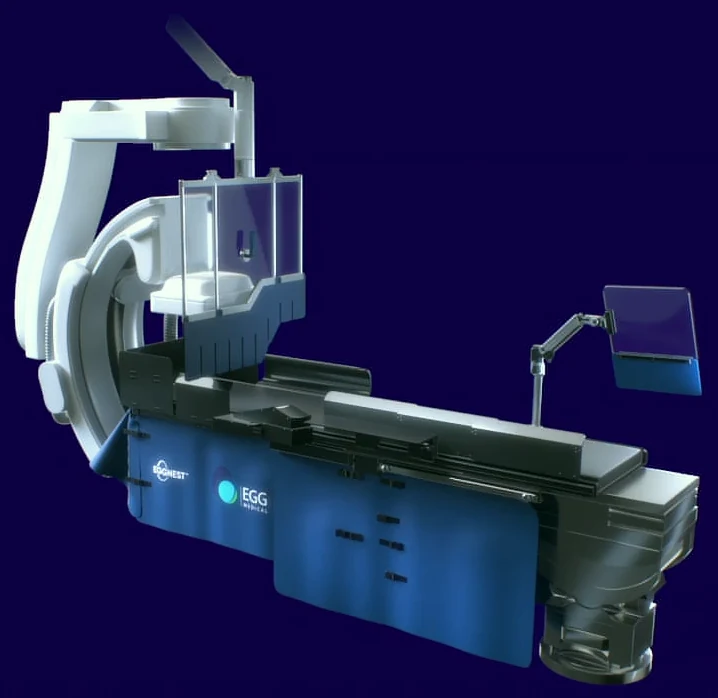
Photo: EggNest in use at Overlake Medical Center, Bellevue, Washington. The study ran at The Christ Hospital.
Read it for yourself
The full paper is free to read in the Journal of the American Heart Association.
Guddeti RR, Schmidt CW, Riley RF, Kamen J, et al. Evaluating standard shielding versus novel enhanced radiation protection devices in the cardiac catheterization laboratory. J Am Heart Assoc. 2026;15(20):e050577. Published online 10 October 2026. doi:10.1161/JAHA.126.050577
| Position | Standard shielding | EggNest Protect | EggNest Complete |
|---|---|---|---|
| Primary operator | 86.7 | 59.3 | 25.5 |
| Assistant | 62.1 | 16.1 | 9.8 |
| Circulating nurse | 26.6 | 8.9 | 10.2 |
| Position | Standard shielding | EggNest Protect | EggNest Complete |
|---|---|---|---|
| Primary operator | 51.4 | 7.0 | 2.4 |
| Assistant | 2.8 | 1.1 | 0.8 |
| Circulating nurse | 1.5 | 1.5 | 0.8 |
Medians, annualized at 300 cases a year. Collar dose per case was lower with both EggNest systems at every position (p ≤ 0.003).
About this study
- Coronary cases at one center. STEMI and emergency cases were excluded.
- Annual figures are estimates from per-case doses, at 300 cases a year.
- The study was funded by an unrestricted grant from Egg Medical to the Lindner Center. Dr. Riley, an author, is Egg Medical’s chief scientific adviser.